How to keep score in basketball
Keeping score means writing down who scored, who fouled and what the score is, as it happens. Here is how to set up the sheet, what to mark for each play and how to check your work.
By Basketball Stat Sheet. Updated .
What you record
The scoreboard shows the total. The book shows how it got there, which is what settles a disagreement at the table. In NBA rules, if a difference in the score cannot be resolved, the running score is official. A scorebook records five things:
- Every basket and free throw, against the player who scored it.
- Every player's fouls.
- The team's fouls in each period, which decide the bonus.
- Each team's timeouts.
- The running score, and the score at the end of each period.
Rebounds, assists and steals are not part of keeping score. Those are player stats, and keeping stats in basketball is a separate job.
Before the game
- Write in both team names, the date and the venue.
- Enter both rosters, jersey numbers first. Numbers are what you will see from the table; names are for reading the sheet afterward. If you only have time for one, take the numbers.
- Mark the five starters for each team.
- Find out your league's foul limit and when the bonus starts. The table further down has the common ones.
What to mark for each play
There is no single standard, so follow the key on your own form. These are the marks on an NCAA-style book, like our NCAA-style scoresheet, and on the official FIBA scoresheet.
| Play | NCAA-style book | FIBA scoresheet |
|---|---|---|
| Two-point basket | A 2 in the player's row | A diagonal line over the new total, with the player's number beside it |
| Three-point basket | A circled 3 in the player's row | The same line, with the player's number circled |
| Free throw made | ⊗ in the player's row | A filled circle over the new total, with the player's number beside it |
| Free throw missed | ○ in the player's row | No mark in the running score |
| Personal foul | The time or period in the player's next foul box | A P in the player's next foul space, plus the number of free throws, such as P2 |
| Team foul | The player's number in the next team-foul box | A large X in that quarter's next team-foul space |
| Timeout | The next box in the team's timeout row | The minute of playing time in the team's timeout box for that half |
How to keep a running score
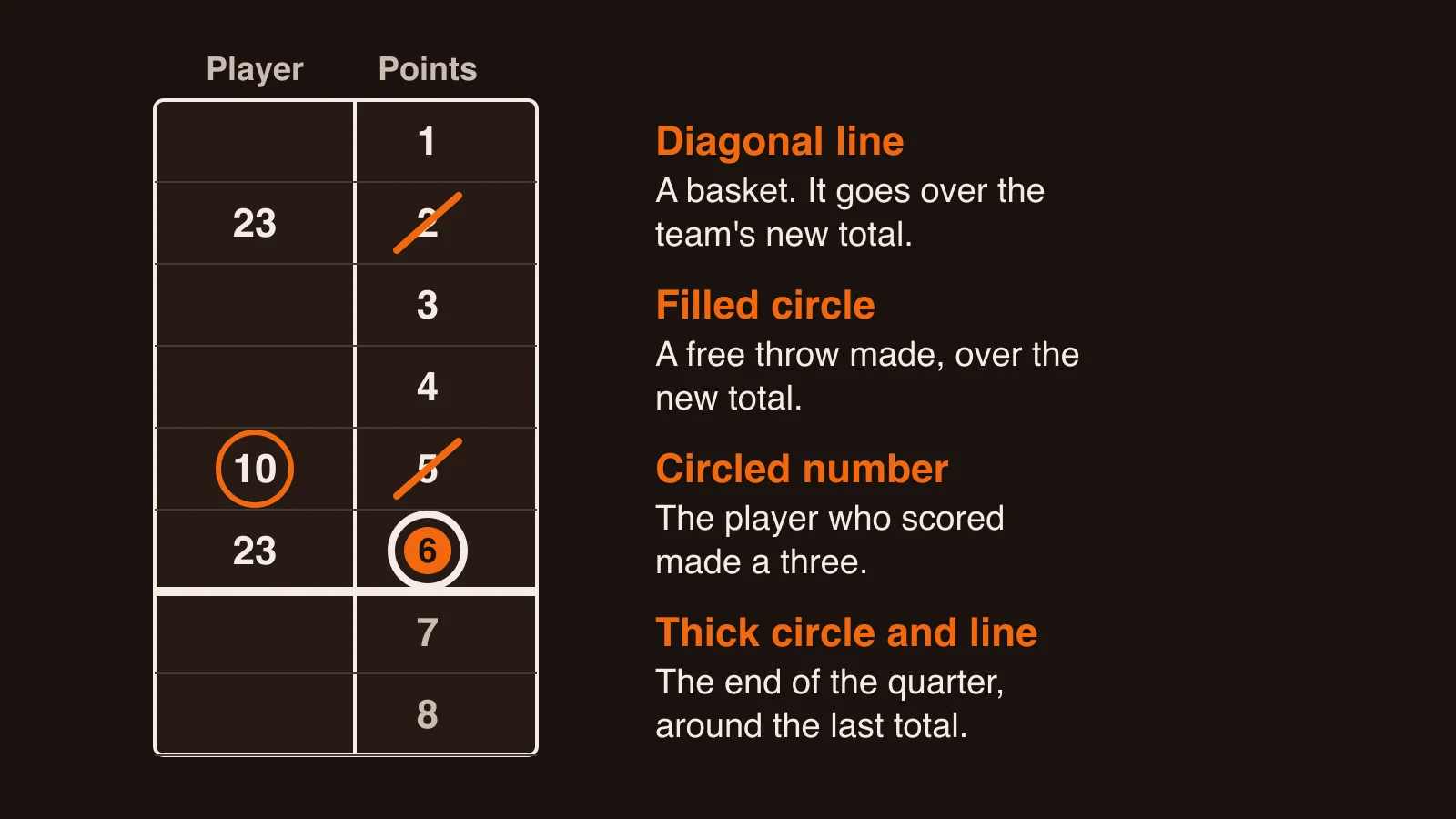
The running score is a column of numbers, one for each point. Every time a team scores, you mark its new total and note who scored. Here is the start of a game for one team, using FIBA marks.
| Play | New total | What to mark |
|---|---|---|
| #23 makes a two | 2 | A diagonal line over 2, with 23 beside it |
| #10 makes a three | 5 | A diagonal line over 5, with 10 beside it, circled |
| #23 makes one of two free throws | 6 | A filled circle over 6, with 23 beside it. The miss adds nothing here |
| The quarter ends | 6 | A thick circle around 6, and a thick line under it and the 23 |
Fouls and the bonus
Every player foul goes in two places: the player's own row and the team's count for the period. Those two counts are the numbers the officials will ask you about, so keep them current. When a player reaches the limit, or a team reaches the bonus, tell the nearest official as soon as you can.
| Rulebook | Fouls to foul out | Bonus starts |
|---|---|---|
| NFHS | 5 | 5th team foul |
| NCAA | 5 | Men 7th (1-and-1), 10th (2) · Women 5th |
| NBA | 6 | 5th (4th in OT) |
| FIBA | 5 | 5th team foul |
Leagues can change these limits, so confirm yours before the game. The basketball rules comparison has the detail for each rulebook.
Checking the book
Check whenever play stops, and always at the end of a period:
- Does the running score match the scoreboard?
- Do the points in the players' rows add up to the running score?
- Do the period scores add up to the total?
- Does each player's foul count match the marks in their row?
If the book and the scoreboard disagree, look first for a free throw you missed or a basket credited to the wrong player. If that does not settle it, tell an official at the next dead ball. FIBA's rules ask the scorer to do the same: if the book is right, get the scoreboard corrected, and if in doubt, tell the crew chief.
The scoreboard says 41 and your running score says 40. The players' rows also add up to 40, so you check your last few marks and find a free throw you did not record. You add it, and all three now agree.
After the game
Enter the final period score, mark the final total, and check the totals one last time. Then keep the sheet: it is the game's record.
Ready to try it? Print a free blank score sheet, or keep the book online with the NCAA-style scoresheet, which adds up the running score for you. If you only need the final score and team fouls, use the score sheet by quarter.