10 Basic Rules of Basketball Every Beginner Should Know
Five players a side, points from shots and free throws, and limits on how you can move with the ball: here is how the game works, in plain English.
By Basketball Stat Sheet. Published . Checked against the FIBA Official Basketball Rules 2026 and the 2026-27 NBA rules.
The aim of basketball is simple: put the ball through the other team's basket and stop them from scoring in yours. When time runs out, the team with more points wins. Most of the rulebook exists to keep that contest fair.
This guide explains the 10 basic rules of basketball, with an example for each one. Two rulebooks come up throughout: FIBA's, used at the Olympics and the World Cup and in most leagues outside North America, and the NBA's. Where they differ, we say so. US high school and college games have their own rules, which you can compare in basketball rules for NFHS, NCAA, NBA and FIBA.
What Are the 10 Basic Rules of Basketball?
No rulebook publishes an official list of ten. These are the ideas a beginner needs first, each one drawn from the full rules:
- Each team has five players on the court.
- Teams score 1, 2 or 3 points by putting the ball through the opponent's basket.
- A player must dribble to move with the ball.
- Traveling is not allowed.
- Double dribbling is not allowed.
- The ball must stay inside the court boundaries.
- Illegal physical contact is a foul.
- Teams must attempt a shot within the shot clock.
- Offensive players cannot stay in the key for more than three seconds.
- The team with the most points at the end wins.
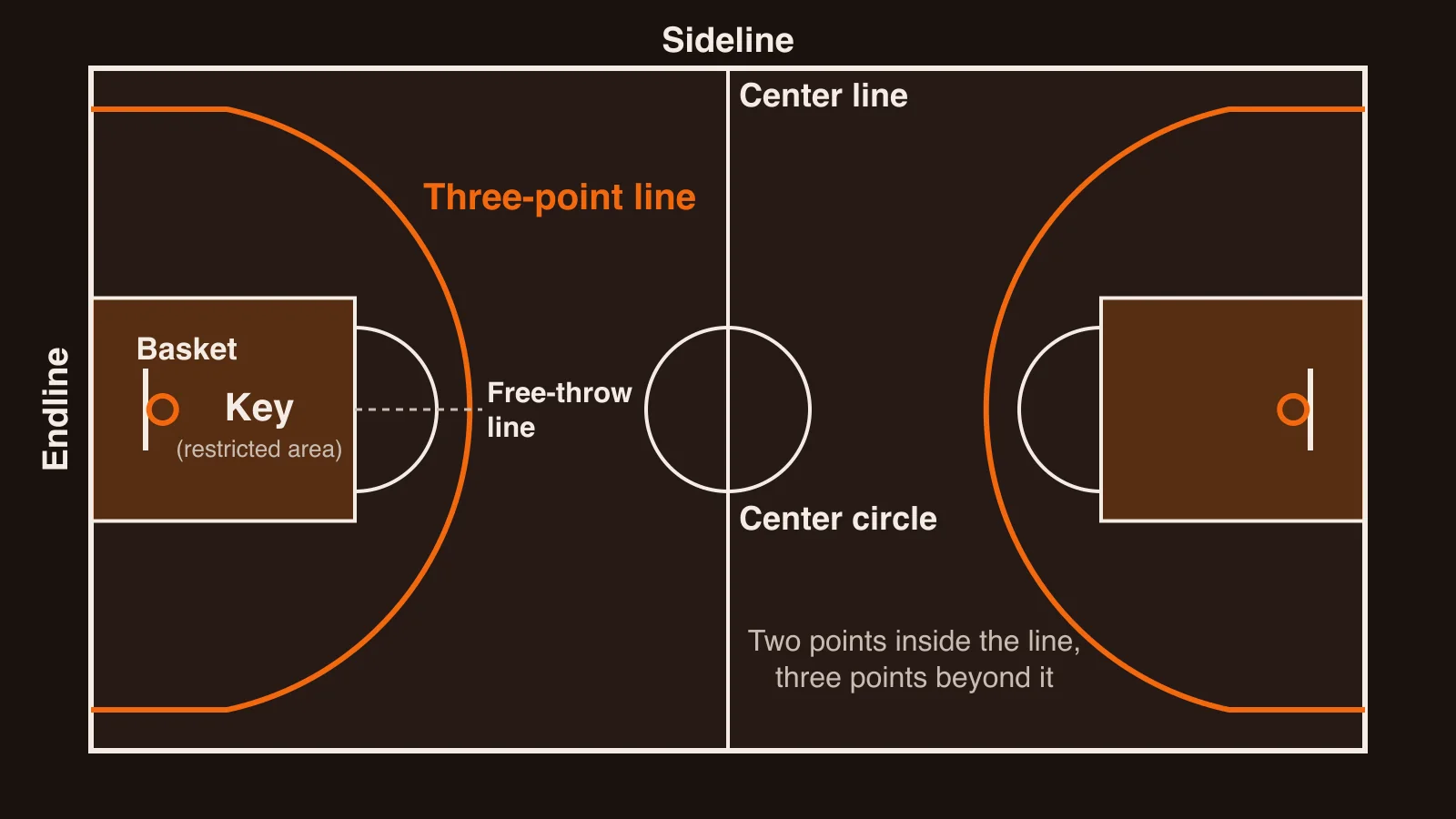
1. Each Team Has Five Players on the Court
Standard basketball is five against five. A full team is bigger than that: FIBA allows up to 12 players entitled to play in a game, and those not on the court are substitutes. Teams can swap players during certain stoppages, such as after a foul.
The rules do not assign positions, but teams usually describe their five like this:
- Point guard (PG): runs the offense and creates chances for teammates.
- Shooting guard (SG): often the team's outside shooter and scorer.
- Small forward (SF): a versatile player who scores, defends and rebounds.
- Power forward (PF): usually plays closer to the basket and rebounds.
- Center (C): usually the player nearest the basket, rebounding and blocking shots.
If a team runs out of substitutes, the two rulebooks part ways. Under FIBA rules it plays on short-handed and loses by default only if it has fewer than two players ready to play. The NBA never lets a team drop below five.
Your center picks up a fourth foul and the coach wants them on the bench. At the next stoppage that allows a substitution, a teammate comes in and the center sits down. The team still has five on the court.
2. Score Points by Shooting the Ball Into the Opponent's Basket
A basket can be worth one, two or three points:
- One point: a free throw, an uncontested shot from the free-throw line, usually awarded after a foul.
- Two points: a shot from inside the three-point line, or with a foot touching it.
- Three points: a shot from behind the three-point line.
What counts is where the shooter last touched the floor. A player who jumps from behind the line and lands inside it still scores three.
A player makes three 3-pointers, two 2-pointers and one free throw. That is 9 + 4 + 1, or 14 points. Those totals are what you see in a basketball box score.
3. Players Must Dribble to Move With the Ball
To travel across the court with the ball, a player has to dribble, which means bouncing it on the floor. The other way to move the ball is to pass it. A player can take as many steps as they like while the ball is out of their hand.
The hand has to stay on top of the ball. Putting a hand under it to carry it, or bringing it to a pause and then continuing to dribble, is a violation often called carrying or palming.
A guard catches the ball at half-court. They can dribble toward the basket or pass to an open teammate. Tucking the ball under one arm and running is not an option.
4. Traveling Is Not Allowed
Traveling means moving your feet illegally while holding the ball. The other team gets the ball and restarts play with a throw-in, a pass from outside the boundary. Two situations cover most calls.
If you catch the ball standing still
The moment you lift one foot, the other becomes your pivot foot, which has to stay in contact with the floor. You can step in any direction with the free foot. To start a dribble, the ball must leave your hand before the pivot foot lifts. To pass or shoot, you may jump off the pivot foot, but you must release the ball before either foot lands.
If you catch the ball moving, or end a dribble
You get two steps to stop, pass or shoot. Step one is the first time a foot or both feet touch the floor after you have control of the ball. If you want to dribble instead, the ball must leave your hand before step two. You also cannot touch the floor twice in a row with the same foot.
That is why counting steps on a replay can mislead you. A step taken before the player had control does not count, so a legal move can look like three steps.
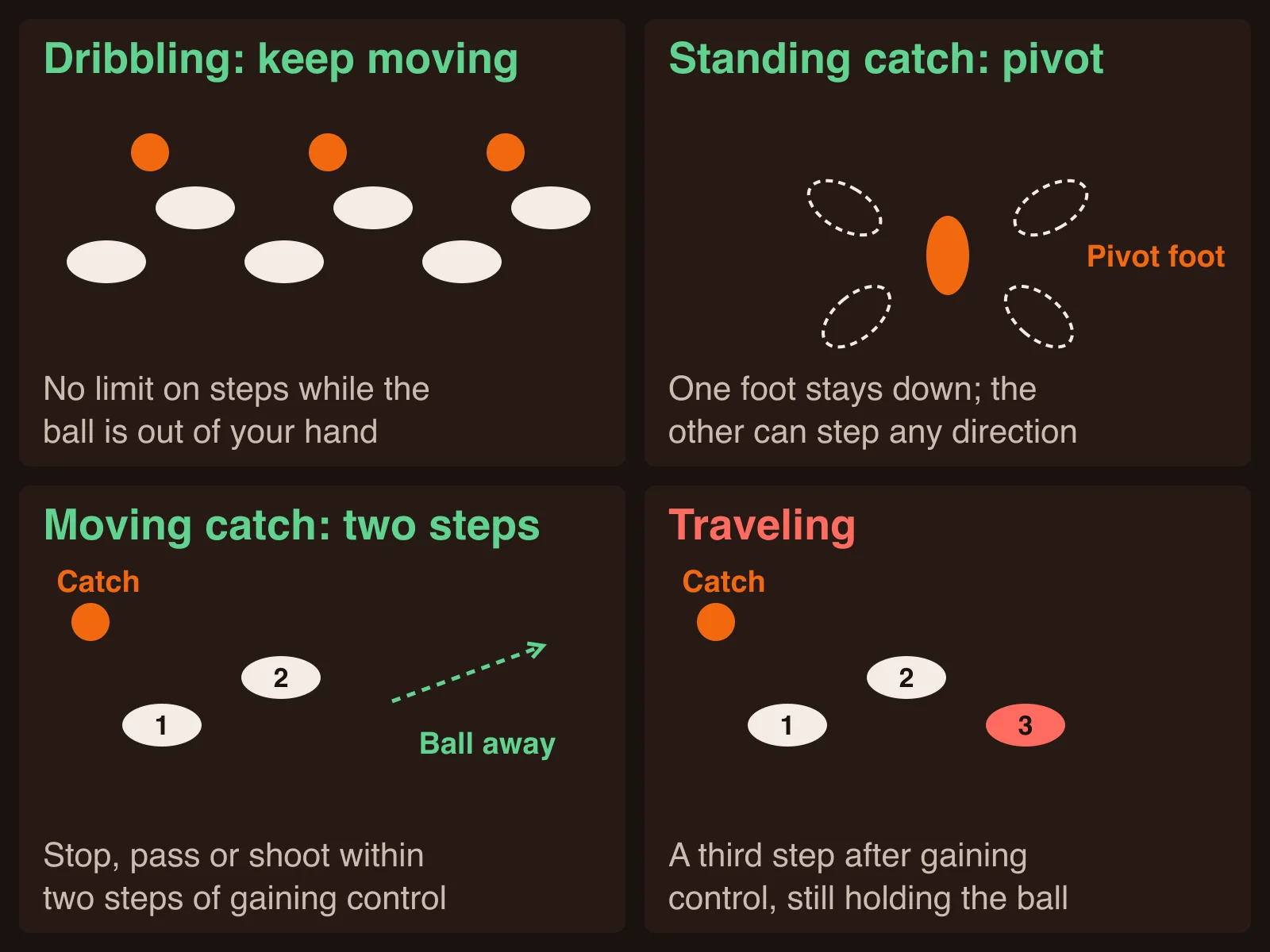
A player catches a pass on the run, takes two steps and lays the ball in. That is legal. A third step before letting go of the ball would be traveling.
5. Double Dribbling Is Prohibited
Your dribble ends when you touch the ball with both hands at once or let it come to rest in your hands. After that you can pass or shoot, but you cannot start dribbling again. If you do, it is a double dribble and the other team gets the ball.
A second dribble is legal only if you lost control of the ball because of one of these:
- You took a shot. In the NBA, it must touch the backboard or the rim.
- An opponent touched the ball.
- Your pass or fumble touched another player. In the NBA, touching your backboard or rim also counts.
A player dribbles to the basket, stops and holds the ball with both hands, then starts bouncing it again. That is a double dribble. If a defender had knocked the ball loose while they held it, they could legally dribble again after recovering it.
6. The Ball Must Stay Within the Court Boundaries
The sidelines and endlines mark the edge of the court, and the lines themselves count as out. A player is out of bounds when any part of their body touches the floor on or beyond a line. The ball is out when it touches the floor or an object on or beyond a line, or a player who is out of bounds.
The team that touched the ball last loses it, and the other team takes a throw-in from near that spot. This rule is about the ball: a player without the ball who steps over a line has not sent anything out of bounds. Under FIBA rules, a player in the air counts as being where they last touched the floor, so you can jump from inside the court and save a ball before you land.
A player dribbling along the sideline steps on the line as the ball comes back to their hand. The other team gets the ball.
7. Players Cannot Commit Fouls or Make Illegal Physical Contact
Basketball is a contact sport up to a point. A personal foul is illegal contact with an opponent:
- Holding: restricting an opponent's movement.
- Pushing: moving an opponent by force with the hands or body.
- Blocking: illegal contact that stops an opponent's progress.
- Charging: pushing or moving into an opponent's torso, usually an attacker running into a defender.
What a foul costs
- Foul on a shooter: two or three free throws if the shot misses, matching its value. If it goes in, the basket counts and the shooter gets one free throw.
- Other fouls: usually a throw-in. Once a team has four team fouls in a quarter, later defensive fouls on non-shooters bring two free throws.
- Fouling out: FIBA removes a player after five fouls of any type, and the NBA after six personal fouls.
Other types of foul
- Technical: often about conduct rather than contact, such as disrespecting a referee.
- Flagrant: contact well beyond a normal foul, penalized with free throws and possession. Used in both rulebooks.
- Disruptive: FIBA only, new in 2026. Non-violent contact that stops a fast break or the clock. With the flagrant foul, it replaces FIBA's old unsportsmanlike foul.
The details differ by league, so see the FIBA basketball rules and the NBA rules explained. On a stat sheet, fouls appear as PF, for personal fouls.
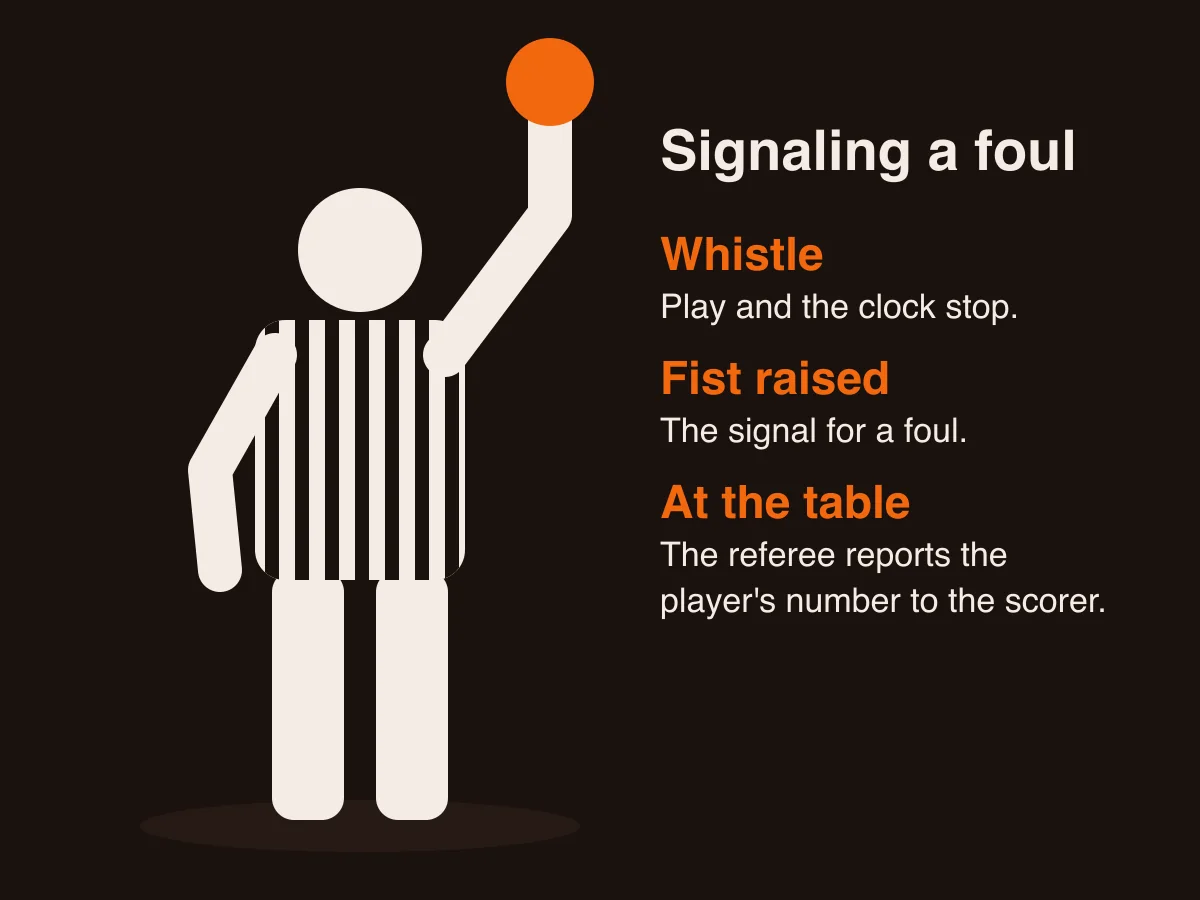
A defender hits a shooter's arm on a three-point attempt that misses. The shooter gets three free throws. If the shot had gone in, it would count for three and the shooter would get one free throw.
8. Teams Must Attempt a Shot Within the Shot Clock
The shot clock limits how long a team can hold the ball without shooting. FIBA and the NBA both give 24 seconds, and a valid attempt needs two things:
- The ball must leave the shooter's hand before the clock expires.
- The ball must then touch the rim or go in. Hitting only the backboard, or nothing at all, is not enough.
If the team fails, the other team gets the ball. After a shot hits the rim, the clock resets to 24 seconds if the other team gets the rebound, and to 14 if the shooting team keeps the ball. Other levels differ: NCAA games use 30 seconds, and US high schools use 35 only in states that adopt a shot clock.
A player releases a shot with one second left, and the buzzer sounds with the ball in the air. It hits the rim and bounces out, so there is no violation and play continues. Had it missed the rim completely, the other team would get the ball.
9. Offensive Players Cannot Stay in the Restricted Area for Too Long
The key, also called the paint, is the marked rectangle from the endline to the free-throw line. FIBA calls it the restricted area and the NBA calls it the lane. Watch out for one trap: in the NBA, "restricted area" means something else, a small half-circle right under the basket.
An attacking player cannot stay in the key for more than three seconds in a row while their team controls the ball in its frontcourt, the half of the court containing the basket it is attacking. The other team gets the ball. Under FIBA rules, referees make allowances for a player who is trying to leave, who is in the key as a shot is released, or who is dribbling in to shoot after less than three seconds there.
The NBA adds a defensive rule that FIBA does not have. A defender in the lane must be actively guarding an opponent, meaning within arm's length and in a guarding position, within three seconds. Breaking it is a technical foul: one free throw, and the offense keeps the ball.
A center stands in the key waiting for a pass. By the count of three they need to step out. Under FIBA rules, both feet must be outside for the count to stop.
10. The Team With the Most Points at the End Wins
FIBA games have four 10-minute quarters, for 40 minutes of regulation playing time. NBA games have four 12-minute quarters, for 48. If the score is tied at the end of the fourth quarter, both rulebooks add as many five-minute overtimes as it takes to break the tie.
The clock stops for many things, including fouls and timeouts, so a game takes much longer than its playing time. Not every level plays the same periods: NCAA men play two 20-minute halves, NCAA women play four 10-minute quarters, and NFHS high school games have four 8-minute quarters.
Team A leads Team B 85-78 at the final buzzer, so Team A wins. If it had been 85-85, they would play a five-minute overtime, with the score carrying on from there.
Quick Summary: 10 Basic Basketball Rules
| Rule | What it means |
|---|---|
| 1. Five players | Five per team on the court in standard basketball, with substitutes on the bench. |
| 2. Scoring | Free throws are worth 1, shots inside the three-point line 2, and shots from behind it 3. |
| 3. Dribbling | Bounce the ball to move with it, or pass it. No carrying. |
| 4. Traveling | Keep your pivot foot down when you catch the ball standing, and take no more than two steps when you catch it moving. |
| 5. Double dribble | Once a dribble ends, pass or shoot. You can dribble again only after a shot, an opponent's touch, or a pass or fumble that touches another player. |
| 6. Out of bounds | The lines count as out. The team that touched the ball last loses it. |
| 7. Fouls | Fouls can cost free throws or possession. A player is out after 5 fouls (FIBA) or 6 personal fouls (NBA). |
| 8. Shot clock | 24 seconds in FIBA and the NBA. The shot must be released in time and then touch the rim or go in. |
| 9. Three seconds | Applies while a player's team controls the ball in its frontcourt. The NBA also limits defenders. |
| 10. Winning | If the score is tied, teams play five-minute overtimes until one team wins. |
FIBA and NBA differences at a glance
| Rule | FIBA | NBA |
|---|---|---|
| Quarters | 4 × 10 minutes | 4 × 12 minutes |
| Regulation time | 40 minutes | 48 minutes |
| Fouling out | 5 fouls of any type | 6 personal fouls |
| Defensive three seconds | No such rule | Technical foul |
| Three-point line | 6.75 m (6.60 m in corners) | 23 ft 9 in (22 ft in corners) |
| Court size | 28 × 15 m | 94 × 50 ft |
Frequently Asked Questions About Basketball Rules
What are the 10 basic rules of basketball?
Five players per team on the court; 1, 2 or 3 points per basket; dribble to move with the ball; no traveling; no double dribbling; keep the ball in bounds; no illegal contact; shoot within the shot clock; no more than three seconds in the key for attackers; and the team with the most points wins. No rulebook publishes this exact list. It is a beginner's summary of the official rules.
What are the five main rules of basketball?
There is no official list of five either. If you only remember a few, make them scoring, dribbling, traveling, fouls and the shot clock, because they explain most of the whistles you will hear.
How many players are on a basketball team?
Five from each team are on the court in standard basketball. The full team is larger: FIBA allows up to 12 players entitled to play in a game, and the rest wait on the bench as substitutes.
How long is a basketball game?
A FIBA game has four 10-minute quarters, or 40 minutes of playing time. An NBA game has four 12-minute quarters, or 48 minutes. Overtime is extra, and because the clock stops during play, a game takes longer than those totals.
How many points is a basketball shot worth?
A free throw is worth one point. A shot from inside the three-point line, or with a foot on it, is worth two. A shot from behind the line is worth three.
What is traveling in basketball?
Traveling is moving your feet illegally while holding the ball, such as lifting your pivot foot and putting it back down before you pass, or taking a third step after you gain control. The other team gets the ball.
What is double dribbling in basketball?
It means dribbling again after your dribble has ended, by touching the ball with both hands at once or letting it rest in your hands. The other team gets the ball. A second dribble is legal only after a shot, a touch by an opponent, or a pass or fumble that touches another player.
How many fouls can a basketball player commit?
Under FIBA rules a player must leave the game after five fouls of any type. In the NBA a player is disqualified on the sixth personal foul. If an NBA team has no eligible substitutes left, that player stays in and the team is charged a technical foul.
What is the 24-second rule in basketball?
A team has 24 seconds to attempt a shot. The ball must leave the shooter's hand before the clock expires and then touch the rim or go in. If the same team gets the ball back after its shot hits the rim, the clock resets to 14 seconds rather than 24.
Conclusion
You now know enough to follow a game: how teams score, what the whistles mean, and why the clock matters. The fastest way to make the rules stick is to watch a game with them in mind, or to keep score of one.
If you want to try that, read how to keep score in basketball, then record a game on the basketball stat sheet or, for just the score, the score sheet by quarter.
Sources
This page summarizes the official rules for beginners; it is not the rulebook itself. Leagues and associations can amend these rules, so check your competition's own regulations for anything that decides a game.
- FIBA Official Basketball Rules 2026 (valid from October 1, 2026)
- NBA Rule No. 1: Court Dimensions and Equipment
- NBA Rule No. 3: Players, Substitutes and Coaches
- NBA Rule No. 5: Scoring and Timing
- NBA Rule No. 7: 24-Second Clock
- NBA Rule No. 10: Violations and Penalties
- NBA Rule No. 12: Fouls and Penalties